The Hidden Battlefield of Heavy-Duty Truck Lifts: Environmental Adaptability and Sustainable Operation
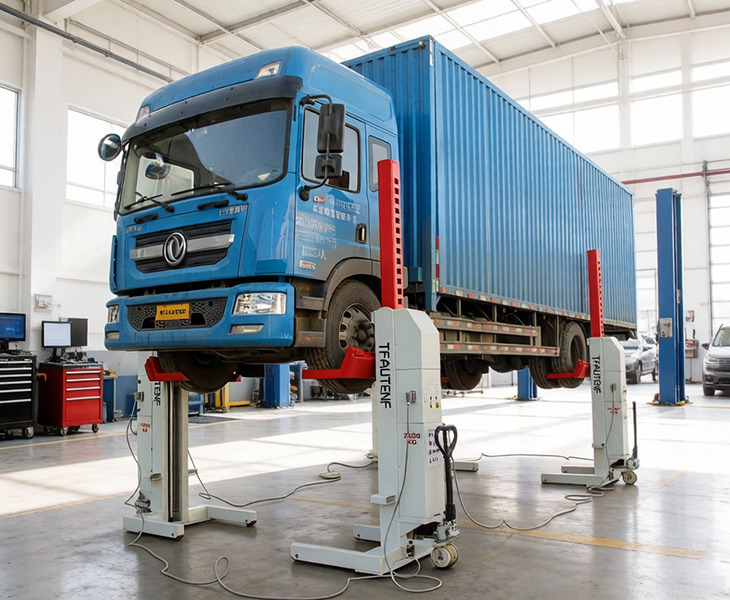
In technical discussions within the heavy‑duty truck repair industry, equipment load capacity and safety often take center stage. However, in today’s context of extreme climates, complex worksites, and increasingly stringent environmental requirements, a lift’s
environmental adaptability and
sustainable operational characteristics are becoming a critical battlefield affecting repair efficiency.
A Professional Approach to Extreme Temperature Conditions
To address the challenges posed by seasonal and regional temperature variations, the core of a professional solution lies in scientific hydraulic‑fluid management. We recommend establishing a regulated seasonal oil‑change routine: in winter, use low‑pour‑point hydraulic oil (e.g., L‑HV32) to ensure reliable startup at temperatures as low as ‑20°C; in summer, switch to a high‑viscosity‑index hydraulic oil (e.g., L‑HM46) to maintain system stability under high‑temperature conditions. By equipping the workshop with simple fluid‑testing tools, repair shops can independently monitor oil condition and perform timely changes when the viscosity index drops by 15%. This proactive maintenance strategy, based on actual operating conditions, offers greater cost‑effectiveness and operational feasibility compared to complex constant‑temperature systems.
Green‑Repair Technological Practices
As global attention to carbon reduction grows, the energy‑consumption performance of repair equipment is becoming a new competitive metric. Efficient electro‑hydraulic systems, through optimized pipeline design and pump‑station matching, can reduce energy consumption by 18‑22% under equivalent working conditions. The combination of quiet‑type motors and vibration‑damping bases keeps operating noise below 70 dB, meeting the environmental requirements of most workshop zones. Moreover, the extended equipment service life resulting from regular maintenance—adding an average of 3‑5 years of operational use—itself represents one of the most substantive sustainable‑development practices.
The true value of equipment lies not only in its specification sheet, but in its ability to continuously create value in real‑world working environments. In an era of changing climates and rising environmental expectations, fully leveraging equipment performance through scientific management and disciplined maintenance is the wise choice for the steady operation of any repair business.